
People often ask, “How many Yoga Sutras are there in total?” The answer is commonly cited as 195 or 196. This collection of short, wise sayings comes from the ancient sage Patanjali. These patanjali yoga sutras give a clear path for the mind to find peace.
The Yoga Sutras are a key text in yoga. They are old, but their ideas still help people today. Patanjali did not invent yoga. But he put together the ideas about yoga in a clear way. He wrote them down as sutras. A sutra is like a thread. It is a short phrase. Many sutras together form a text. The total number of sutras helps us see how Patanjali organized his teachings.
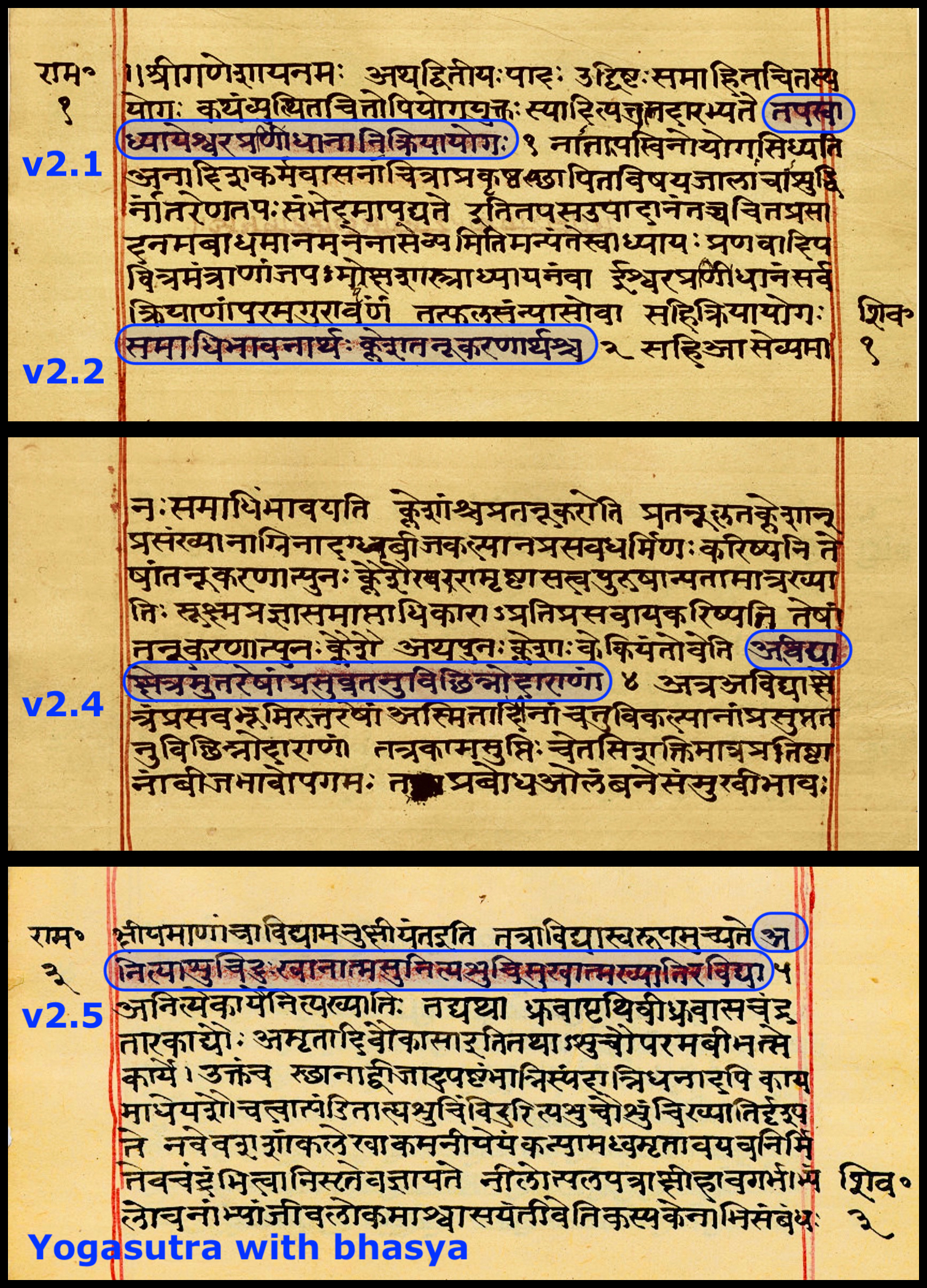
Image Source: upload.wikimedia.org
Grasping Patanjali and His Teachings
Who was Patanjali? We don’t know for sure when he lived. It might have been around 200 CE or even earlier. Some people think there might have been more than one person named Patanjali. The Patanjali we talk about is the one who wrote the Yoga Sutras. He is seen as a great teacher. His work gives us the core of yoga philosophy.
The sutras are like a guide. They show the way to calm the mind. They show the way to connect with your true self. This true self is often called the soul or spirit. The path is not just about body poses. It is about training the mind.
The structure of yoga sutras is very organized. They are split into parts. These parts are called Padas. Each Pada talks about a different part of the path. Knowing this structure helps us learn the teachings.
Exploring the Total Number of Sutras
As mentioned, the total number of sutras is usually listed as 195 or 196. Why two numbers? Different versions of the text exist. Some versions group the sutras slightly differently. Some may add or leave out one sutra at the end. But the main teachings are the same. The core message stays true.
Most scholars agree on about 195-196 sutras. This number is small compared to other long books. But each sutra holds deep meaning. They are short on purpose. They were meant to be memorized. Students would learn them from a teacher. The teacher would explain the deep meaning.
Even though the number is small, the ideas cover a lot. They talk about why we suffer. They talk about how to stop suffering. They talk about reaching freedom. The total number of sutras gives us the full picture Patanjali wanted to share.
Navigating the Structure of the Yoga Sutras
The patanjali yoga sutras are divided into four books or chapters. These are called Padas. Think of them as steps on a path. Each Pada builds on the last one. They take you deeper into the practice and philosophy of yoga. The yoga sutras padas are:
- Samadhi Pada (Chapter on Contemplation)
- Sadhana Pada (Chapter on Practice)
- Vibhuti Pada (Chapter on Powers or Results)
- Kaivalya Pada (Chapter on Liberation)
Let’s look at each Pada. Each one has a special focus. Together, they form a complete guide. They show the journey from a troubled mind to a free one.
Here is a simple look at the Padas:
| Pada Name | Focus | Key Ideas | Approximate Number of Sutras |
|---|---|---|---|
| Samadhi Pada | The Goal & The Mind | What is Yoga? How the mind works. Reaching deep peace (Samadhi). Different types of Samadhi. Ways to calm the mind. | ~51 |
| Sadhana Pada | The Path of Practice | How to practice yoga. Kriya Yoga (action yoga). The cause of suffering. The Eight Limbs of Yoga. Yamas and Niyamas. Asana and Pranayama basics. | ~55 |
| Vibhuti Pada | Results & Powers | What happens when you practice well. Siddhis (special powers). How powers can distract. Focusing the mind (Dharana, Dhyana, Samadhi). | ~56 |
| Kaivalya Pada | Freedom & Liberation | What happens when you reach freedom. Knowing your true self. Letting go of old habits. The goal of yoga. Liberation from suffering. | ~34 |
Adding these numbers up (51 + 55 + 56 + 34) gives us 196 sutras. Some texts might have one less in the last chapter, making it 195. This table helps see the whole structure. It shows how the 195 or 196 sutras are organized.
Exploring the Samadhi Pada
The first chapter is the samadhi pada. It sets the stage. It tells us what yoga is. Patanjali starts right away. The most famous sutra is in this chapter: Yoga citta vritti nirodhah. This means: Yoga is stopping the mind’s movements. Or, Yoga is calming the changing states of the mind. This is the core idea of patanjali’s philosophy. The goal of yoga is to quiet the busy mind.
The Samadhi Pada talks about the mind. It describes the “vrittis.” These are the thoughts, feelings, and memories that move in the mind. Like waves on a lake. When the waves are calm, you can see the bottom. When the mind is calm, you can see your true self.
The Pada lists different ways the mind moves:
* Right knowledge (seeing things as they are)
* Wrong knowledge (mistake or illusion)
* Fancy (imagining things)
* Sleep (the mind in a different state)
* Memory (recalling past things)
It also talks about how to quiet these movements. Two main ways are mentioned:
* Practice (Abhyasa): Working steadily at calming the mind. Doing this over a long time. Doing it with effort and care.
* Non-attachment (Vairagya): Letting go of desires. Not being pulled by likes and dislikes. Not wanting things to be different than they are.
The Samadhi Pada explains different levels of deep peace, or Samadhi.
* Samprajnata Samadhi: Here, the mind is focused. It is still aware of the object it is focused on. There are levels within this, based on how fine the focus is.
* Asamprajnata Samadhi: This is a deeper state. The mind is completely still. There is no object of focus. Only pure awareness remains. This state comes from intense practice and non-attachment.
This first Pada is very important. It defines yoga. It explains the mind. It shows the high goal of the practice. It gives the basic tools (practice and non-attachment) to start. The roughly 51 sutras in this section lay the foundation for the rest of the text.
Exploring the Sadhana Pada
The second chapter is the sadhana pada. Sadhana means practice or discipline. This chapter tells you how to do yoga. It gives practical steps. It answers the question: How do I quiet my mind?
Patanjali starts by talking about Kriya Yoga. Kriya Yoga means “yoga of action.” It has three parts:
1. Tapas: Heat or discipline. Effort. Working hard at the practice.
2. Svadhyaya: Self-study. Looking at yourself honestly. Also, studying wise texts like the Sutras.
3. Ishvara Pranidhana: Letting go to a higher power. Trusting in something larger than yourself. Surrendering the results of your actions.
These three practices help weaken the “kleshas.” Kleshas are causes of suffering. They are like roots of pain in the mind.
The five main kleshas are:
* Avidya: Not knowing. Not seeing reality clearly. This is the root klesha.
* Asmita: “I-am-ness.” Thinking “I” am separate from everything else. Ego.
* Raga: Wanting. Attachment to pleasant things.
* Dvesha: Not wanting. Dislike. Pushing away unpleasant things.
* Abhinivesha: Fear of death. Clinging to life.
The Sadhana Pada explains that avidya (not knowing) is the source of suffering. From not seeing clearly, we build an ego, we want things, we dislike things, and we fear losing it all.
To deal with these kleshas, Patanjali gives us the famous eight limbs of yoga (ashtanga yoga). This is a step-by-step path. It is found mainly in the Sadhana Pada. These limbs work together. They help purify the body and mind. They lead towards Samadhi.
The eight limbs are:
- Yama: Ways to act towards others and the world. These are outer disciplines.
- Ahimsa: Non-violence. Kindness in thought, word, and deed.
- Satya: Truthfulness. Speaking and living truth.
- Asteya: Non-stealing. Not taking what is not freely given.
- Brahmacharya: Using energy wisely. Often means self-control, especially in sensual matters.
- Aparigraha: Non-possessiveness. Not being greedy. Letting go of things.
- Niyama: Ways to act towards yourself. These are inner disciplines.
- Saucha: Cleanliness. Keeping the body and mind clean.
- Santosha: Contentment. Being happy with what you have.
- Tapas: Discipline, effort. (Same as in Kriya Yoga).
- Svadhyaya: Self-study, studying texts. (Same as in Kriya Yoga).
- Ishvara Pranidhana: Letting go to a higher power. (Same as in Kriya Yoga).
- Asana: Body posture. Sitting still and steady for meditation. Later traditions developed many yoga poses from this.
- Pranayama: Breath control. Working with the life force (prana) through breathing exercises.
- Pratyahara: Drawing senses inward. Pulling back the senses from outside objects. Like a turtle pulling in its limbs.
- Dharana: Focusing the mind. Holding attention on one point. Concentration.
- Dhyana: Steady focus. Meditation. The mind stays focused without effort.
- Samadhi: Deep peace. Union. The mind is completely still. The state talked about in the first Pada.
The Sadhana Pada describes the first five limbs in detail. It explains how they help prepare the ground for deeper practice. It talks about the effects of following Yamas and Niyamas. It explains how Asana makes the body stable. It shows how Pranayama controls energy. It teaches how Pratyahara gives power over the senses.
This chapter gives the practical steps. It tells us what to do on the path. The roughly 55 sutras here form the core practice guidelines.
Exploring the Vibhuti Pada
The third chapter is the vibhuti pada. Vibhuti means power, result, or manifestation. This chapter talks about what happens when you practice well. It describes the deeper states of focusing the mind (Dharana, Dhyana, Samadhi). These three together are called Samyama. Samyama is a powerful tool. It is putting concentration, meditation, and deep peace together on one object.
When you do Samyama on something, you gain special knowledge or power about it. The Vibhuti Pada lists many “siddhis.” Siddhis are these special powers. They can be things like:
* Knowing past and future
* Knowing what others are thinking
* Becoming very small or very large
* Walking on water
* Having strength like an elephant
* Gaining knowledge of faraway stars
* Controlling the elements
The Vibhuti Pada explains how these powers might arise from deep practice. For example, Samyama on the relationship between the body and space might lead to the power of levitation.
However, Patanjali gives a warning. These siddhis can be a distraction. They are results of practice, but they are not the goal. The goal is Kaivalya (liberation). Siddhis can make the practitioner feel special or powerful. This can feed the ego (Asmita), which is a klesha. If you get stuck on the powers, you stop moving towards freedom.
So, the Vibhuti Pada shows the results of deep practice. But it also warns against getting attached to them. It reminds us that the true goal is beyond any power or special ability. The roughly 56 sutras in this chapter explore the deeper results of focus and the potential pitfalls.
Exploring the Kaivalya Pada
The fourth and last chapter is the kaivalya pada. Kaivalya means isolation, solitude, or liberation. This is the goal state. It is the state of freedom. This chapter talks about what liberation is like. It explains the process of reaching it.
The Kaivalya Pada describes how the mind becomes free from its old patterns. The kleshas (suffering roots) are gone or burned away. The stored actions and their results (karma) stop affecting the person in the old way.
Patanjali explains that the true self (Purusha) is always pure and free. It is the mind (Chitta) that gets mixed up with the world and its changes. Kaivalya is when the mind is completely quiet. It reflects the pure light of the true self without any distortion. It is like a clean mirror. The mirror doesn’t become the image. It just reflects it perfectly. In Kaivalya, the mind realizes its true nature is distinct from the pure awareness of Purusha, yet the mind itself dissolves or becomes perfectly still, leaving only the pure awareness.
This state is not lonely, as the word “isolation” might suggest. It is a state of complete freedom from suffering and limitations. It is realizing that you are not the changing mind or body. You are pure consciousness.
The Kaivalya Pada also talks about different ways people might seem to reach special states. It says true liberation comes from deep spiritual practice, not from things like drugs, special herbs, or being born with certain qualities. Only the path of intense effort, as described in the Sadhana Pada, leads to lasting freedom.
This final chapter explains the high point of the yoga journey. It shows the nature of ultimate reality according to Patanjali’s philosophy. The roughly 34 sutras here bring the text to its end, describing the state beyond suffering.
Interpreting Patanjali’s Philosophy
Patanjali’s philosophy is called Yoga Darshana. It is one of the six main systems of Indian thought. It is closely linked with Samkhya philosophy. Samkhya talks about two main parts of reality:
* Purusha: Pure consciousness. The true self. It is unchanging. It is the witness.
* Prakriti: Everything else. Nature. The mind, body, world, thoughts, feelings. It is always changing.
Patanjali’s philosophy says suffering happens because Purusha (consciousness) gets mixed up with Prakriti (the changing world). We think we are our thoughts, our body, our feelings. We forget we are pure consciousness.
The goal of patanjali’s philosophy is to stop this mixing up. It is to see clearly that Purusha is separate from Prakriti. This seeing clearly is called Viveka Khyati. It is the knowledge that frees you.
The whole system of the Yoga Sutras is built on this idea. The practices (Sadhana) are designed to quiet the mind (Prakriti). When the mind is quiet, it stops blocking the light of Purusha. Then, the true self shines through. This leads to Kaivalya.
The famous sutra Yoga citta vritti nirodhah fits here. Yoga is stopping the changes of the mind (Prakriti’s movements). When the mind stops changing, the Seer (Purusha) rests in its own true nature. This is freedom.
Patanjali’s system is dualistic. It sees Purusha and Prakriti as separate. But the goal is the realization of this separation. It’s not about separation in a lonely way. It’s about knowing what is eternal and what is temporary.
Exploring the Eight Limbs of Yoga in Detail
The eight limbs of yoga are key to the practice part (Sadhana Pada). Let’s look at them more closely. They offer a full path for living and practicing.
-
Yamas (Outer Disciplines): These are how you relate to the world. They are like moral guidelines.
- Ahimsa (Non-violence): This is the most important Yama. It means not causing harm. Not just to others, but also to yourself. Not harming with actions, words, or even thoughts. It is about kindness and compassion. If you practice Ahimsa deeply, hostility drops away in your presence.
- Satya (Truthfulness): Being truthful. Speaking truth. But also, being true to yourself. Truth should not cause harm (Ahimsa comes first). Speak truth kindly and helpfully.
- Asteya (Non-stealing): Not taking what is not yours. This includes not taking credit for others’ work. Not wasting resources. Not stealing time. When you practice Asteya, riches may come to you. This isn’t about getting rich. It means you are not lacking anything because you are content and honest.
- Brahmacharya (Using energy wisely): Often linked to celibacy, but it means more broadly using your energy and senses in a way that supports your spiritual path. Not wasting energy on things that distract from the goal. It’s about moderation and self-control.
- Aparigraha (Non-possessiveness): Not being greedy. Taking only what you need. Letting go of things you don’t need. Not being attached to possessions. When you practice Aparigraha, you gain knowledge of your past and future lives. This means you see how attachment creates cycles, and letting go frees you from them.
-
Niyamas (Inner Disciplines): These are how you treat yourself and your inner life.
- Saucha (Cleanliness): Keeping your body clean. Keeping your surroundings clean. Also, keeping your mind clean. Letting go of negative thoughts. Clearing out old mental clutter.
- Santosha (Contentment): Being happy with what you have. Accepting your life as it is right now. This doesn’t mean not working to improve, but finding peace in the present moment. From contentment comes great joy.
- Tapas (Discipline, Effort): Putting in effort for practice. Sticking to your sadhana even when it’s hard. This builds inner strength. It burns away impurities.
- Svadhyaya (Self-study): Looking at yourself honestly. Knowing your strengths and weaknesses. Also, studying wise texts like the Yoga Sutras or other scriptures. This helps you understand yourself and the path.
- Ishvara Pranidhana (Letting go to a higher power): Giving yourself over to something bigger than you. Trusting in a divine force or the universe. Letting go of control. This leads to Samadhi.
-
Asana (Posture): This is the most known part of yoga today. In Patanjali’s time, it meant a steady, comfortable seat for meditation. The posture should be stable and easy. Being able to sit still for a long time helps quiet the mind.
-
Pranayama (Breath Control): Prana is life force. Ayama means extending or controlling. Pranayama exercises work with the breath to control and direct this life force. This calms the nervous system and prepares the mind for deeper states.
-
Pratyahara (Sense Withdrawal): The senses constantly pull our attention outside. Pratyahara is learning to draw that attention inward. It’s not about blocking senses, but about choosing where to put your attention. Like a turtle pulling its limbs into its shell.
-
Dharana (Concentration): Focusing the mind on one point. This could be a physical object, a sound, or an idea. It’s training the mind to stay still. Like pouring oil without breaks.
-
Dhyana (Meditation): This is a deeper state of focus. The mind flows towards the object of focus without effort. The meditator is still aware of the process.
-
Samadhi (Deep Peace / Union): The final limb. The mind becomes one with the object of focus, or simply rests in pure awareness. The meditator loses sense of being separate from the focus point. This is the state of deep peace talked about in the first Pada.
The eight limbs are not always practiced one after the other in a strict way. They support each other. For example, practicing Yamas and Niyamas helps make Asana and Pranayama more effective. And Asana and Pranayama help prepare for the inner limbs (Pratyahara, Dharana, Dhyana, Samadhi).
This path of eight limbs covers ethical living, physical practice, breath control, sense control, and mental training. It is a complete system given within the Sadhana Pada.
The Yoga Sutras Today
Why are these old sutras still important? The world has changed. But the human mind is much the same. We still face stress, wanting things, and not understanding ourselves. The Yoga Sutras give timeless wisdom for these problems.
They offer a path that is not based on any specific religion. It is based on understanding the mind and working with it. The patanjali yoga sutras give a science of the mind.
Today, many people know yoga mainly through Asana (body poses). This is just one small part of the eight limbs. The Sutras remind us that yoga is much more. It is a way of life. It is a path for the mind and spirit.
Reading the Sutras helps us see the deeper goal of yoga practice. It helps us put our physical practice into a larger context. It shows us how to live a yogic life off the mat.
The total number of sutras might seem small. But each one is packed with meaning. Studying them can be a lifelong journey. Many teachers have written explanations (commentaries) to help understand them.
Interpreting the Sutras
The Sutras are short and sometimes hard to understand. They were meant to be taught by a teacher. Different teachers and traditions interpret them in slightly different ways. This is why there are many commentaries on the Yoga Sutras.
The challenge is to find the meaning that speaks to you. To see how the ancient words apply to your life today. It takes study, reflection, and practice to grasp their depth.
For example, the idea of Ishvara (a higher power) is mentioned. Different people understand Ishvara in different ways. It could be a personal God, a universal consciousness, or just the idea of pure potential. The Sutras leave room for personal belief within the framework of the practice.
The beauty of the Sutras is their flexibility. They offer clear steps. But they also invite personal exploration. They point the way, but you must walk the path yourself.
Conclusion: The Count and The Journey
So, how many Yoga Sutras are there total? The most common count is 195 or 196. These are divided into four Padas: Samadhi, Sadhana, Vibhuti, and Kaivalya.
- Samadhi Pada defines yoga and the goal.
- Sadhana Pada gives the practical steps, including the eight limbs of yoga.
- Vibhuti Pada talks about the results of deep practice and the dangers of powers.
- Kaivalya Pada describes the final state of liberation and freedom.
These patanjali yoga sutras give a complete guide. They start with the problem (suffering mind) and end with the solution (freedom). They show the path of patanjali’s philosophy. This path is not just exercise. It is a way to train the mind and find lasting peace.
Knowing the total number of sutras is less important than exploring their meaning. Each sutra is a point of light. Together, they light up the path of yoga. They show that the goal of yoga is not just a flexible body. It is a free mind and a clear spirit.
Whether you count 195 or 196, the wisdom held within these yoga sutras padas remains the same. It is an invitation to look inward, to practice discipline, and to discover the quiet, free nature of your true self.
Frequently Asked Questions
h4 How many chapters are in the Yoga Sutras?
There are four chapters. They are called Padas. The names are Samadhi Pada, Sadhana Pada, Vibhuti Pada, and Kaivalya Pada.
h4 What is a ‘sutra’?
A sutra is a short phrase or verse. It is like a thread. It is meant to be easy to remember. It contains deep meaning that needs to be explained by a teacher or commentary.
h4 What is the main idea of Patanjali’s Yoga Sutras?
The main idea is that yoga is stopping the changes of the mind (Yoga citta vritti nirodhah). When the mind is calm, you realize your true self, which is pure consciousness, free from suffering.
h4 What are the Eight Limbs of Yoga?
They are a path of practice given by Patanjali. They include Yamas (outer guides), Niyamas (inner guides), Asana (posture), Pranayama (breath), Pratyahara (sense control), Dharana (focus), Dhyana (meditation), and Samadhi (deep peace).
h4 Do I need to read all the Yoga Sutras to practice yoga?
You do not need to read all of them to start practicing. Many people begin with Asana or Pranayama. But reading and studying the Sutras can help you understand the deeper purpose of yoga beyond just physical exercise. It helps you see the full path Patanjali described.
h4 Is there only one version of the Yoga Sutras text?
There are different versions and traditions. The total number of sutras is usually 195 or 196 depending on how they are counted in a specific version. The core teachings are the same across these versions.
h4 Are the Yoga Sutras religious?
The Yoga Sutras give a philosophy and practice path. They are not tied to one specific religion. The concept of Ishvara (a higher power) is mentioned, but it is open to interpretation. The focus is on direct experience through practice, not religious belief.
h4 Can the Yoga Sutras help with stress?
Yes, the Sutras offer many practices aimed at calming the mind and reducing suffering. The techniques like Yamas, Niyamas, Asana, Pranayama, and meditation are all tools that can help manage stress and find inner peace.